Developed by a 100% Romanian-owned company, the project foresees cumulative investments exceeding €400 million and will establish a complete industrial value chain in Romania — from resource extraction to high added-value products.
Mineral Proiect Invest S.A. (MPI) announces the award of the Concession License for the exploitation of magnesian rock resources (magnesian serpentines) within the Valea Dobra perimeter, Sibiu County. The license was approved under Order No. 529 of September 3, 2026, and published in the Official Gazette of Romania, Part I, No. 754 of September 7, 2026.
The award of the license marks a new development phase for MPI Magnesium, the first integrated industrial magnesium project in the European Union to reach this advanced stage — one that combines the exploitation of a European resource with its processing in Romania, ensuring that added value is created within the European Union.
At a time when the European Union is working, through the Critical Raw Materials Act, to strengthen access to critical raw materials and reduce dependence on external suppliers, the investment in Sibiu County has the potential to contribute to the development of new European production and processing capacities. Magnesium is used across major industrial sectors, including automotive, aerospace, and electronics.
A Strategic Resource — Mined and Processed in Romania
The deposit at Valea Dobra, near the town of Rășinari, holds estimated resources of over 50 million tonnes.
The defining characteristic of MPI Magnesium is the development of the full value chain within Romania, so that the added value of the resource is created domestically rather than exported as raw ore. The project is designed to transform the ore into high-purity products for European industries. In later development phases, the production process may be extended to include metallic magnesium.
Developed in stages, the investment will generate jobs, contributions to local budgets, and new economic opportunities for communities in Sibiu County.
“Obtaining the exploitation license is a defining moment for MPI Magnesium and for the project we have been building for several years. Romania holds a significant resource, but its true value emerges only when we go beyond extraction and develop the full industrial chain here. Our goal is to turn this resource into a European source of high added-value magnesium products and thereby contribute to reducing one of the European Union’s strategic dependencies,” said Andrei Degeratu, President and Chief Executive Officer of Mineral Proiect Invest S.A.
From Rășinari to Săliște: Added Value and Green Mining
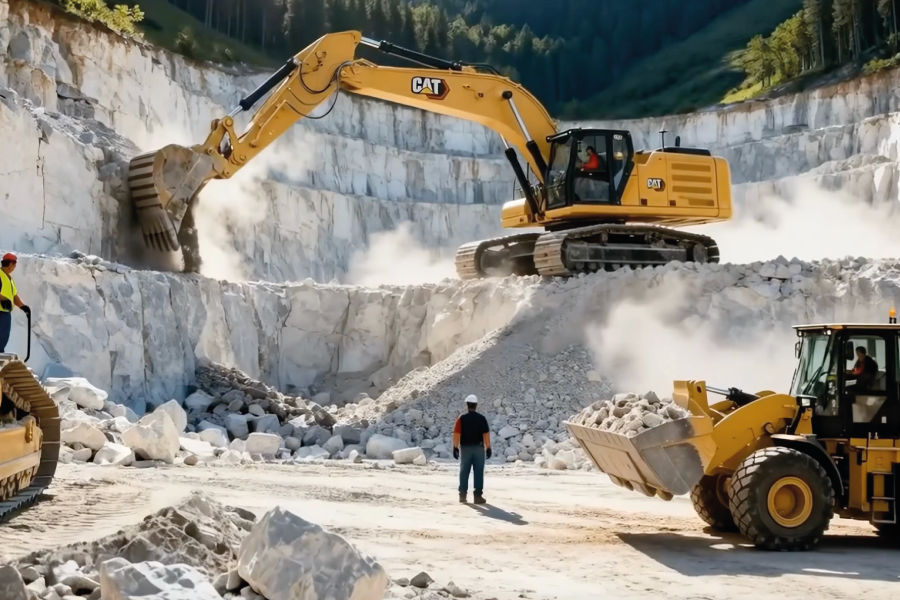
The first component of the project involves the exploitation of the Valea Dobra deposit, where primary crushing will take place at the extraction site. The material will then be transported to the processing plant in Săliște for advanced processing stages.
The products envisaged within the project have applications across key industrial sectors:
- Magnesium hydroxide [Mg(OH)₂] is used, among other applications, as a halogen-free flame retardant in the cable, plastics, construction, automotive, and electronics industries.
- High-purity magnesium oxide (MgO) and fused magnesia are used in metallurgy and steelmaking — including refractory materials for furnaces operating at very high temperatures — as well as in technical ceramics and other high-temperature industrial applications.
The environmental dimension is built into the logistics design from the outset. MPI Magnesium plans to transport ore via a funicular system, along with the use of 100% electric dump trucks in the logistics flow to the processing plant in Săliște.
This configuration is designed to significantly reduce conventional heavy road traffic and, consequently, the CO₂ emissions, dust, and noise associated with mining transport — an important consideration both for local communities and in the context of the area’s natural and tourism character.
Through these solutions, MPI Magnesium pursues a modern green mining model in which the exploitation of a strategic resource is accompanied, from the design phase, by measures aimed at reducing the environmental impact of mining and logistics operations.
A Romanian Project Addressing a European Vulnerability
The European Union faces significant import dependency in the supply of magnesium and magnesium-based products, exposing European industries to the risks associated with the concentration of global supply chains. In this context, the development in Europe of a chain that integrates mineral resources and industrial processing acquires strategic relevance.
The Critical Raw Materials Act seeks to strengthen European value chains for critical raw materials and to develop extraction, processing, and recycling capacities within the European Union.
“Europe needs not only access to resources, but also the capacity to transform them into industrial products within the European Union. This is the rationale behind the MPI Magnesium project: extraction, processing, and added value — all created in Romania. The exploitation license represents an essential step in the transition from an identified resource to the next stages of development of this industrial project,” said Petru Văduva, Vice-President of Mineral Proiect Invest S.A.
Investments Exceeding €400 Million, Backed by Romanian Industrial Expertise
MPI Magnesium is designed for modular, phased development, enabling the pace of investment and the progressive expansion of capacities to be aligned with project evolution and market demand. In the full development scenario, cumulative investments will exceed €400 million.
In the first phase, investment will focus on developing the mining operation and building the processing plant in Săliște for the production of MgO and Mg(OH)₂, with the project subsequently expanding into fused magnesia and other high added-value products.
MPI Magnesium is developed by Mineral Proiect Invest S.A., a 100% Romanian-owned company that brings together, within the project, specialists and partners from Romania and abroad, with experience in mining, processing, engineering, and the development of complex industrial projects.
The project also benefits from the expertise of major Romanian engineering and infrastructure companies within the group to which MPI belongs — Electromontaj, Emfor, Iproeb, and Electrotehnica EM — all involved in the development and execution of large-scale projects in Romania and on international markets.
Together, these companies recorded combined revenues of over €250 million in 2025 and employ more than 1,650 people, bringing together the technical, industrial, and execution capabilities relevant to a project of the scale of MPI Magnesium.